AI search visibility is whether answer engines such as ChatGPT, Perplexity and Google's AI Overviews can read your website, understand it and cite it when a buyer asks a question. It's the AI-era version of ranking on Google, measured in citations rather than positions.
It matters because buyers now research this way before they speak to anyone. A CEO asks ChatGPT for the options, reads a synthesised answer and arrives at a shortlist. If your website isn't one of the sources behind that answer, you're not on the shortlist.
Nectiv, a search agency, recently set out six factors that make a page easy for AI to cite. It's a good checklist, written for SEO practitioners. I've translated it for the people who own the outcome. Each factor below comes with the question I'd ask the team, and the decision that only leadership can make.
Can AI tools actually read your website?
Possibly not. Most major AI crawlers read only the raw HTML your server sends, and don't run JavaScript.
Vercel and MERJ tracked AI crawler traffic across Vercel's network and found no evidence that OpenAI's, Anthropic's or Perplexity's crawlers execute JavaScript. Google's Gemini is the exception, because it uses Googlebot's renderer. Many modern websites build their content in the browser with JavaScript. To those crawlers, the page is close to empty.
The check takes two minutes. Open one of your key pages, right-click, choose View Page Source and search for a sentence from your main copy. If it isn't there, AI crawlers probably can't see it either.
The decision is whether to let AI crawlers in at all. Training crawlers take your content into future models. Search crawlers fetch it live to answer a buyer's question. Blocking one isn't the same as blocking the other. That's a commercial call about how you want to be found, and it shouldn't be left to whoever manages the robots.txt file.
Does each key page answer the buyer's question first?
It needs to, because AI tools cite the top of a page far more than the rest of it.
Kevin Indig's analysis of 18,012 verified ChatGPT citations found 44.2% came from the first 30% of a page. His team also found that 78.4% of citations tied to questions came from headings. AI treats a heading as the question and the paragraph beneath it as the answer.
This is why the slow-build introduction costs you. A page that spends three paragraphs on context before saying what you do gives AI nothing to lift. The answer has to sit in the first few sentences, and each sentence has to make sense on its own if it's quoted out of context.
The decision is what the answer actually is. What do you do, for whom, and why should a buyer choose you over the alternatives? If the leadership team can't agree that in four sentences, no amount of page structure will fix it. That's positioning, and it sits with you.
Could a buyer compare you with the alternatives in ten seconds?
If your pricing, services and comparison pages are written as long prose, probably not, and AI tools favour structure.
Nectiv found ChatGPT answers are around 2.3 times more likely than Google results to include a table. AI tools prefer content they can lift cleanly: tables, numbered steps, and headings in a clear order, with each H3 sitting under the right H2.
Take a professional services firm that describes three service tiers across four paragraphs. Compare that with a table showing each tier, who it's for, what's included and the typical price. The second version gets used, by buyers and by AI.
The decision is what you're willing to be compared on. A table forces you to state price ranges, scope and who you're not for. Many businesses avoid that because it feels exposing. Your buyers are comparing you anyway, with or without your input.
Who owns keeping your website current?
Someone has to, by name, because AI tools drop stale pages quickly.
AirOps found that pages left more than three months without an update are over three times more likely to lose citations, and that more than 70% of cited pages had been refreshed within the past year. AirOps sells content refresh software, so treat the exact figures with some care. The direction is consistent with other research.
Freshness means a visible "last updated" date, current figures and facts that are still true. A 2024 statistic on a 2026 page tells AI tools and buyers the same thing. Nobody's looking after this.
The decision is ownership. In most growing businesses, the website gets updated when someone has a quiet week. Name one owner, give them a review cycle for the ten pages that matter most, and put it on the monthly agenda.
Are your FAQs built from real sales conversations?
They should be. FAQ sections match the way people prompt AI tools, which makes them some of the easiest content on your site to cite.
Most FAQ pages are written by marketing, guessing what buyers want to know. The questions come out polished and generic. The questions that earn citations are phrased the way buyers phrase them. How long before we see results? What happens if we stop after three months? Do you work with businesses our size?
Those questions are already sitting in your sales team's inbox and call notes. They rarely make it onto the website.
The decision is to get sales and marketing talking. A monthly half hour where sales hands over the five questions they heard most is enough. It sounds basic. In most businesses I see, it doesn't happen.
What do buyers ask before they'd ever find you?
More than they type, because answer engines split every question into several hidden searches.
When a buyer asks ChatGPT for the best option, it runs follow-up searches in the background, known as fan-out queries. AirOps traced this across more than 500,000 retrieved pages and found only 15% were cited in the final answer. Being found is the first step. Answering the specific follow-up questions is what earns the citation.
So a page about outsourced payroll for manufacturers needs to cover the questions a buyer asks along the way: cost, switching risk, compliance and how long setup takes. A page that only restates the service gets retrieved and passed over.
The decision is understanding the buying journey, which is strategy rather than SEO. Which questions sit between a buyer first noticing the problem and choosing a supplier? Your best clients can tell you. Ask three of them.
The six questions at a glance
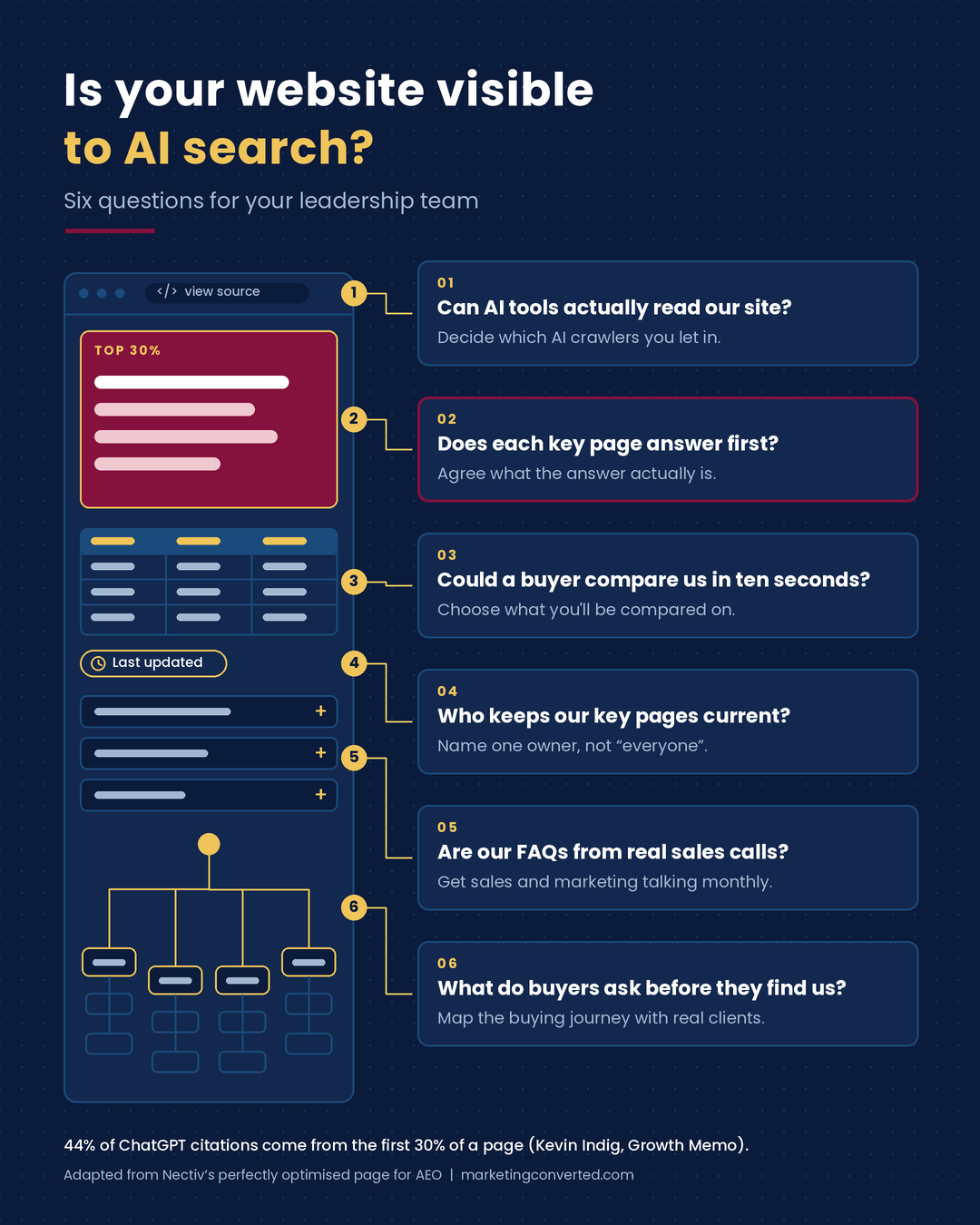
| Factor | The question to ask your team | The decision that sits with leadership |
|---|---|---|
| AI accessibility | Can AI tools actually read our site? | Which AI crawlers we let in |
| Answer first | Does each key page answer the buyer's question first? | What our answer actually is |
| Structure | Could a buyer compare us in ten seconds? | What we're willing to be compared on |
| Freshness | Who keeps our key pages current? | One named owner and a review cycle |
| FAQs | Are our FAQs from real sales calls? | Sales and marketing meeting monthly |
| Fan-out | What do buyers ask before they find us? | A mapped buying journey |
What should you do this month?
Start with the five pages that matter most to a buyer: usually the home page, your services or pricing page, and your strongest comparison or case study pages.
- Run the View Source test on each of those five pages
- Rewrite the first four sentences of each to answer the buyer's question
- Name one owner for keeping them current, and set a review date
Everything after that, the schema, the tables, the FAQ markup, can be handled by your team, an agency or AI tools. What makes it work is that it's directed by someone who owns the plan.
When those decisions are made, the implementation is the easy part. Your website starts showing up in the answers your buyers read before they ever contact you, and it stays there because someone is looking after it.
If you'd like to talk through how visible your business is in AI search, . If you want to see how I use AI on live client work, including where it gets things wrong, the Agent Library shows the agents I run.
Frequently asked questions
What is answer engine optimisation (AEO)?
Answer engine optimisation is the practice of structuring your website so AI tools such as ChatGPT, Perplexity and Google's AI Overviews can read it and cite it. It covers technical access, page structure, freshness and answering the questions buyers actually ask. It builds on SEO rather than replacing it.
Does AI search replace SEO?
No. Strong SEO still helps, because AI tools retrieve pages from search indexes before deciding what to cite. The difference is that ranking is no longer the finish line. A page can be retrieved and still not be cited if it doesn't answer the question clearly.
How do I know if my business appears in AI answers?
Ask ChatGPT, Perplexity and Google the questions your buyers ask, and note which sources each one cites. Use the same set of questions every month so you can see whether you're gaining or losing ground. Paid tracking tools exist, but a consistent manual check is enough to start.
Should we block AI crawlers from our website?
For most B2B service businesses that want to be found, blocking AI search crawlers means opting out of the answers buyers read. Training crawlers are a separate decision, about whether your content is used to train future models. Treat them as two commercial decisions, not one technical setting.
Who should own AI search visibility in a growing business?
The same person who owns the marketing plan. The tactics can be delegated to a team, an agency or AI tools. The decisions behind them, positioning, what you're compared on and who keeps pages current, need one senior owner.
Sources
- Nectiv, "The Perfectly Optimized Page For AEO"
- Vercel and MERJ, "The rise of the AI crawler"
- Kevin Indig, Growth Memo, "The science of how AI pays attention"
- Nectiv, "ChatGPT citations are 2.3x more likely to include a table than Google search"
- AirOps, "The 2026 State of AI Search"
- AirOps, "Influence of retrieval, fan-out and Google SERPs on ChatGPT citations"